Highlights
- Forklifts move heavy, bulky, and palletized materials faster than manual handling methods.
- The right forklift can reduce product damage, labor demands, and order-processing delays.
- Different forklift models support specialized tasks, including stacking, loading, picking, and narrow-aisle operation.
- Organized forklift routes help warehouses maintain smoother and safer workflows.
- Operator training, daily inspections, and preventive maintenance reduce avoidable disruptions.
- Forklifts deliver the greatest value when they are integrated with inventory systems and warehouse planning.
How Do Forklifts Make Warehouse Operations More Efficient?
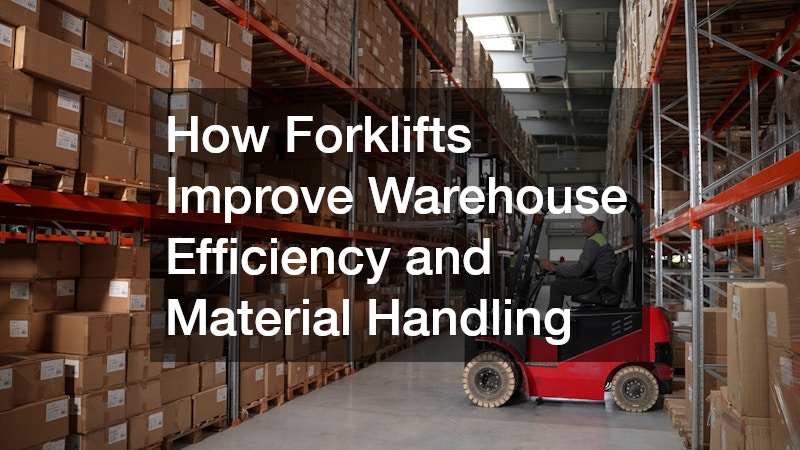
Forklifts improve warehouse efficiency by enabling workers to move large quantities of materials quickly, safely, and with less physical effort. Instead of transporting individual boxes or relying on teams of employees to move heavy products, a trained operator can relocate an entire pallet in a single trip.
This ability accelerates receiving, storage, picking, replenishment, and shipping activities. The Occupational Safety and Health Administration describes forklifts as powered industrial trucks primarily used to move, raise, lower, or remove materials stored on pallets or in containers. By shortening the time required for these routine tasks, forklifts help warehouses process more orders during each shift. They also allow workers to concentrate on inventory accuracy, quality control, equipment checks, and other responsibilities that require direct attention.
Why Are Forklifts Essential for Modern Material Handling?
Forklifts are essential because warehouses regularly handle materials that are too heavy, tall, bulky, or numerous to move efficiently by hand. A forklift can transport palletized goods from a loading dock to a storage location, lift inventory onto elevated racks, and retrieve products when orders are ready for fulfillment. This versatility creates a consistent flow of materials throughout the facility. Forklifts also support around-the-clock logistics operations in industries where products must be shipped continuously. The U.S. Bureau of Labor Statistics notes that material-moving machine operators use equipment to transport objects and may work overnight shifts because materials are shipped at all hours. Without reliable lift equipment, many facilities would experience slower turnaround times, greater physical strain on employees, and increased difficulty managing high-volume inventory.
What Warehouse Tasks Can Forklifts Complete?
Forklifts support almost every major stage of warehouse material handling. Their usefulness extends beyond carrying pallets across a floor because specialized models and attachments can be selected for particular loads, aisle widths, rack heights, and operating conditions. Common forklift-supported tasks include:
- Unloading pallets from trailers, delivery trucks, and shipping containers
- Moving incoming materials to receiving and inspection areas
- Placing products onto elevated warehouse racks
- Replenishing forward-picking locations from reserve storage
- Transporting completed orders to packing and shipping stations
- Moving oversized, irregularly shaped, or heavy materials
- Loading outbound shipments in the correct sequence
- Removing empty pallets, packaging materials, and recyclable waste
OSHA explains that powered industrial trucks can move large objects or groups of smaller objects stored in boxes, crates, pallets, and other containers. This flexibility allows warehouses to use forklifts across multiple departments rather than limiting them to a single loading area.
How Do Forklifts Help Warehouses Use Space More Effectively?
Forklifts help warehouses take advantage of vertical storage space, which can increase capacity without expanding the building. Reach trucks and other lifting equipment allow products to be stored on tall rack systems instead of occupying valuable floor space. Narrow-aisle models can operate in compact layouts, enabling facilities to install additional rack rows while preserving access to inventory. Better space utilization can shorten travel distances, reduce congestion, and make frequently requested products easier to retrieve. However, equipment must be matched carefully to aisle widths, rack heights, surface conditions, and load requirements. OSHA notes that different types of powered industrial trucks present different operating hazards, so warehouse design should account for the specific vehicle being used. A layout that supports safe turning, lifting, visibility, and pedestrian separation helps convert available space into practical storage capacity.
How Can Forklifts Reduce Labor Demands and Product Damage?
Forklifts reduce labor demands by replacing repetitive manual lifting and carrying with controlled mechanical movement. One operator can transport loads that might otherwise require several employees, freeing additional team members for picking, packing, receiving, and inventory management. Forklifts may also reduce product damage when loads are properly secured, pallets are in good condition, and operators follow safe handling procedures. Stable movement helps prevent cartons from being dropped, dragged, crushed, or stacked incorrectly. Warehouses can strengthen these benefits by standardizing pallet sizes, setting load limits, maintaining level travel surfaces, and selecting attachments designed for unusual materials. Efficiency should never come from rushing, overloading equipment, or taking unsafe shortcuts. OSHA’s powered industrial truck standards cover the safe design, operation, use, and maintenance of forklifts, reinforcing the connection between responsible equipment management and dependable warehouse performance.
What Practices Make Forklift Workflows More Productive?
Warehouse leaders can improve forklift productivity by planning routes and reducing unnecessary movement. Effective practices include:
- Creating designated forklift lanes and pedestrian walkways
- Placing fast-moving inventory near packing and shipping areas
- Organizing receiving zones so pallets can be inspected without blocking traffic
- Using warehouse management software to assign efficient storage locations
- Scheduling battery charging, refueling, and maintenance outside peak periods
- Matching forklift capacity and mast height to expected loads
- Training operators on the facility’s layout, hazards, and procedures
- Monitoring travel time, idle time, damage incidents, and equipment utilization
- Keeping aisles, intersections, and loading areas clear of obstructions
These steps allow forklifts to follow predictable routes rather than competing for space with pedestrians, pallets, and other equipment. Productivity improves when operators know where materials belong, which route to use, and whether the destination is ready to receive the load. Clear processes reduce waiting, backtracking, congestion, and avoidable handling.
Why Do Training and Inspections Affect Efficiency?
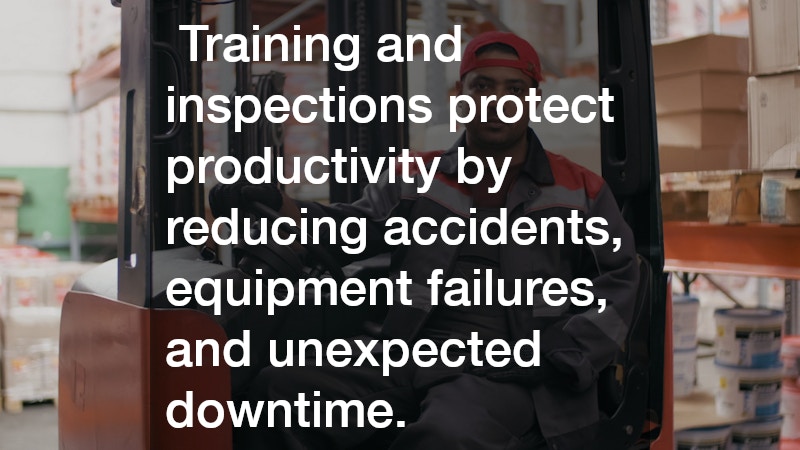
Training and inspections protect productivity by reducing accidents, equipment failures, and unexpected downtime. A forklift that develops a steering, braking, tire, fork, hydraulic, or warning-device problem can interrupt operations and create serious hazards. Daily pre-shift inspections give operators an opportunity to identify these concerns before the truck enters a busy warehouse. The National Institute for Occupational Safety and Health recommends thorough inspections of powered industrial trucks, including commonly used sit-down forklifts, narrow-aisle reach trucks, pallet lifts, and tow tractors. Operators should also understand load capacity, stability, visibility limitations, parking procedures, and pedestrian awareness. When a safety-related defect is found, the equipment should be removed from service until it can be evaluated and repaired. This preventive approach is more efficient than responding to a collision, dropped load, injury, or major mechanical breakdown.
Why Will Forklifts Remain Central to Warehouse Efficiency?
Forklifts will remain central to warehouse operations because they solve one of logistics’ most important challenges: moving large quantities of material safely and efficiently through limited space. Their ability to transport, lift, stack, retrieve, and load goods makes them valuable at nearly every stage of fulfillment. Yet the equipment alone does not guarantee better performance. Warehouses achieve the strongest results when they choose the right truck, design efficient routes, train operators, inspect equipment daily, and maintain each forklift consistently. These practices reduce delays while protecting workers, products, and facility infrastructure. By integrating forklifts into a well-planned material-handling strategy, warehouse leaders can increase throughput, improve space utilization, and build operations that remain dependable as inventory volumes and customer demands grow.
Sources
- Occupational Safety and Health Administration, “Powered Industrial Trucks—Forklifts”:
https://www.osha.gov/powered-industrial-trucks - National Institute for Occupational Safety and Health, “Conducting a Daily Inspection of Powered Industrial Trucks”:
https://www.cdc.gov/niosh/publications/numbered/2022-100.html - U.S. Bureau of Labor Statistics, “Material Moving Machine Operators”:
https://www.bls.gov/ooh/transportation-and-material-moving/material-moving-machine-operators.